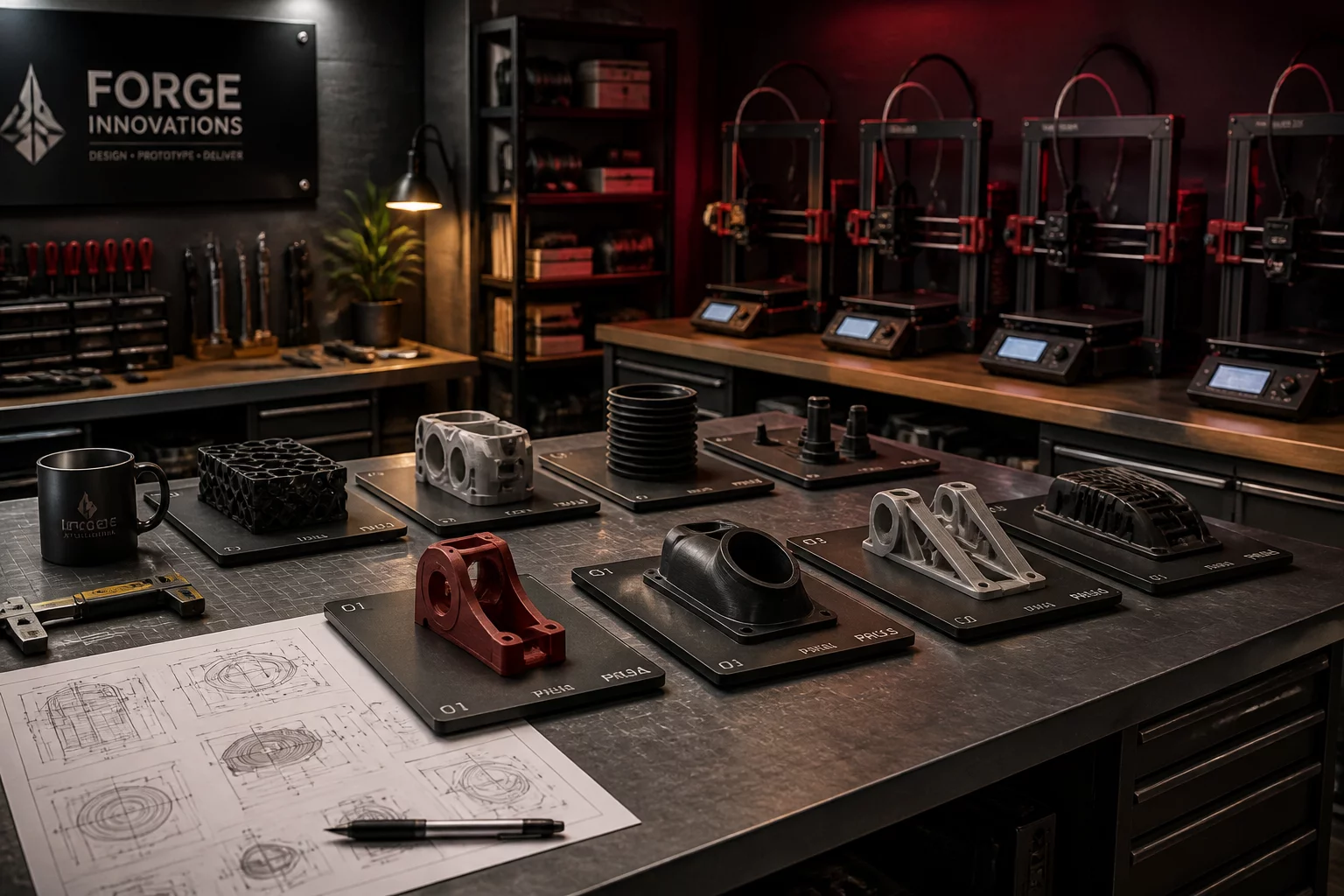
Plate-Role Architecture Over Auto-Packing
The Deterministic Role Assignment Rule
Modern consumer and industrial slicers encourage random geometric auto-packing to maximize bed density. While convenient for batch trinkets, this creates critical failure cascades when producing 20+ component mechanical assemblies. A single warping corner ruins five unrelated precision hinges and cosmetic covers simultaneously.
PlateRole Notebook documents a structured separation model: dividing print beds into deliberate operational roles based on thermal sensitivity, filament chemistry, mechanical tolerance tiers, and post-processing dependencies.
Reduction in prototype assembly turnaround by sequencing load-bearing core plates ahead of cosmetic skins.
Tolerance Categorization
Preventing friction fits from cooling unevenly next to tall hollow enclosures. Plates are grouped by exact kinematic priority.
Thermal Profile Clustered
Eliminates chamber temperature conflicts. Fast draft parts remain segregated from slow high-infill nylon core plates.
Shift-Aligned Scheduling
Arranging day-time visual inspect prints and unattended overnight plates according to explicit risk and print-time profiles.
Who Benefits From Plate Role Planning
Product Engineering
Hardware startups and prototype labs fabricating functional enclosures. Plate roles prevent internal snap-fit brackets from sharing build surfaces with outer finish panels.
- Strict dimensional repeatability
- Isolated structural test runs
- Standardized slicer metadata
Complex Assembly Builders
Robotics enthusiasts, RC modeling creators, and multi-part maker projects. Staging plates according to sub-assembly stages ensures parts are ready exactly when assembly starts.
- Zero workbench clutter
- Progressive mechanical testing
- Immediate fastener fit verification
Small-Scale Production
Micro-factories producing 10 to 50 kit units. Role categorization ensures identical replacement parts can be reprinted on single designated plates without re-slicing entire sets.
- Minimal scrap during misprints
- Predictable machine turn times
- Simplified QA inspection stages
Independent Publication Notice
PlateRole Notebook is an autonomous educational and research portal dedicated to advancing digital fabrication workflows. This platform is completely independent and is not affiliated with, sponsored by, authorized by, or endorsed by Bambu Lab, Tuozhu Technology, or any 3D printer hardware and slicer software manufacturer.
All references to slicer profiles, plate operations, Bambu Studio terminology, or trademarked brand names exist solely for educational demonstration, technical compatibility instruction, and non-commercial workflow analysis.